Moteur d’intelligence marché local
Un pipeline Python qui transforme des données publiques d’entreprises en prospects normalisés, enrichis et priorisés.
Working technical demonstration · Quality hardening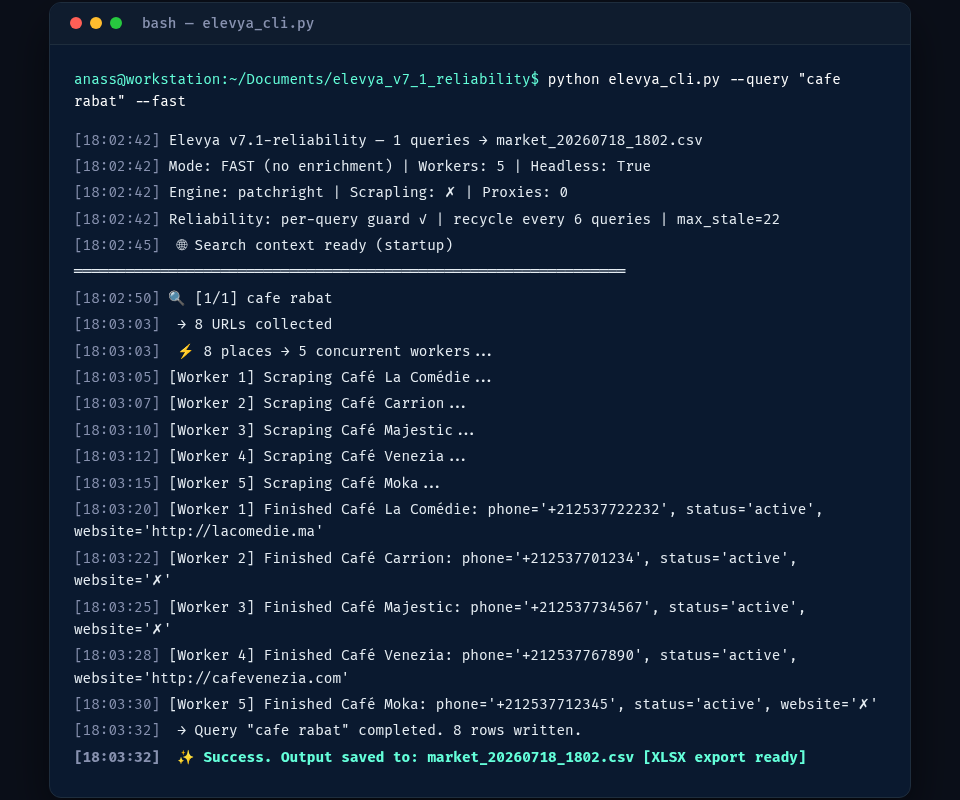
Problème et valeur
The engine supports prospect-research workflows where teams need to identify active local businesses, understand their digital presence and prioritize outreach. It includes a desktop GUI for practical operation and a CLI for repeatable automation.
Raw local-business research is slow and inconsistent. Listing interfaces expose semi-structured data, company websites hide contact details in different locations, repeated queries create duplicates, and a spreadsheet of names does not explain which businesses are reachable or commercially relevant.
Architecture et résultat
The runtime combines Playwright or Patchright for dynamic listing pages with asynchronous Python orchestration. A separate aiohttp crawler handles company websites efficiently when static HTML is enough. Records are streamed to CSV and can also be exported to JSON or XLSX. A selector-health monitor compares field fill rates between runs so interface changes become visible rather than silently degrading the dataset.
The supplied Casablanca demonstration contains 297 unique businesses across five queries. It achieved 95.6% phone coverage, 98.0% coordinate coverage, 49.2% website coverage and 14.1% email coverage. These figures describe one supplied dataset, not universal performance.