Engineering a unified Moroccan tourism platform from discovery to reservation and payment
A decoupled Laravel and React product connecting tourism discovery, recommendations, bookings and CMI payment workflows.
| STATUS | Two-person academic product · Functional demonstration |
|---|---|
| TEAM | Two-person project |
| DEMO | Functional demo deployment planned |
| SOURCE | Private project source |
Résumé Exécutif
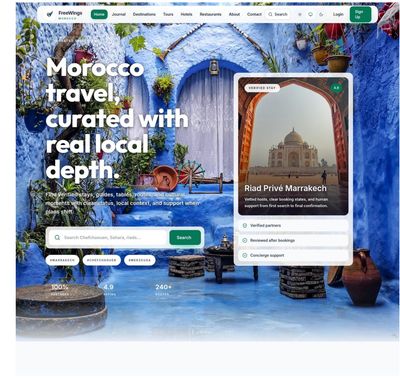
FreeWings is a two-person final-cycle product exploring a unified Moroccan tourism experience. It brings destinations, hotels, tours, restaurants, activities and editorial content into one discovery journey, then connects search and recommendation to a polymorphic booking flow and a real integration with CMI — Morocco's interbank card payment gateway — implemented with HMAC-SHA512 signing, idempotent webhook handling and transactional reconciliation, running in certification/preproduction mode.
Context
Travellers researching Morocco bounce between a hotel site, a tour operator, a restaurant listing and a blog, then often book nowhere in particular because nothing connects the pieces into one journey. FreeWings, built for a licence-level final-cycle project at SUPMTI with my partner Oumaima Bakkali, tests whether a single product — for travellers, tourism professionals and administrators — can hold that whole journey without collapsing the real differences between what a hotel, a restaurant and a multi-day tour actually need to sell.
My role and ownership
- Shared product and technical design
- Laravel REST API and domain modelling
- React/TypeScript product interface
- Search, recommendation and booking workflows
- Payment, security and observability design
Personal contribution
Shared architecture and implementation across API, SPA, booking, payment, security and observability.
Le Problème
A hotel, a restaurant and a guided tour are not the same kind of thing to sell — different pricing logic, different availability rules, different cancellation terms — but a traveller wants to compare and book all three without noticing the difference underneath. On top of that, a payment gateway callback can arrive twice, arrive late, or arrive with a tampered amount, and a booking system that isn't built for that will either double-charge someone or lose track of whether they paid at all.
AVANT
- Fragmented tourism discovery across unrelated services
- No shared search and recommendation experience
- Different reservation flows for each service type
- Payment callbacks vulnerable to duplicate processing without idempotency
- Limited cross-layer visibility into failures
APRÈS
- One catalogue spanning destinations, hotels, tours, restaurants and activities
- Unified search and recommendation experience
- Polymorphic booking lifecycle shared across service types
- HMAC-SHA512 validation, amount checks and idempotent reconciliation design
- Request IDs, HTTP telemetry, Web Vitals and client error reporting
Résultat significatif : One coherent product experience across discovery, reservation and payment states.
La Solution
Two independent applications talk over REST. Laravel handles routing, FormRequest validation, Policy-based authorization, services and API resources; React handles the interface with TanStack Query for server state and Zod for typed validation. A booking is polymorphic — one bookings table serves hotels, tours and restaurants alike via bookable_type/bookable_id — so adding a fourth service type doesn't mean building a fourth booking system from scratch.
Payment runs in three phases: the backend signs a payload with HMAC-SHA512 and hands the traveller off to CMI's hosted checkout, so card data never touches FreeWings' own servers; CMI posts a webhook back, verified against the signature, checked for amount match, and processed through a firstOrCreate idempotency guard so a duplicate callback is silently absorbed instead of double-processed; and the traveller's return page polls booking status every five seconds until the reconciliation lands. A parallel observability layer — request IDs, HTTP telemetry, Web Vitals, client-side error reporting via sendBeacon — exists so a failure anywhere in that chain is diagnosable, not a mystery.
Ingénierie
Two independent applications communicate through REST. Laravel organizes routes, middleware, FormRequests, controllers, policies, services, models and API resources. React uses TypeScript, TanStack Query, Zod and feature-oriented components. The recommendation score is computed directly in SQL — rating times 20, plus review count times 4, plus active hotels, restaurants, tours and activities weighted separately — ordered with orderByRaw so ranking stays fast without pulling every destination into PHP to sort it.
Decoupled API and SPA
The split supports a richer customer experience and reusable contracts, while requiring deliberate authentication and deployment coordination.
Polymorphic booking model
Hotels, tours and activities share reservation lifecycle logic without forcing every service into an identical data model.
Idempotent payment reconciliation
CMI callbacks may repeat, so signature checks, amount validation and controlled reconciliation protect reservation and payment state.
Client and server instrumentation
Request IDs, HTTP telemetry, Web Vitals and sendBeacon error reporting connect user experience with backend diagnostics.
Visual Proof
Le Résultat
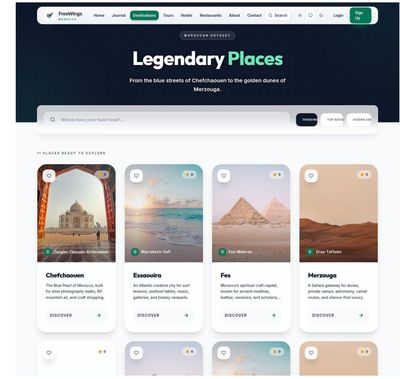
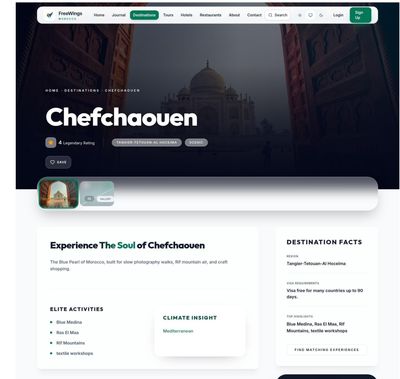
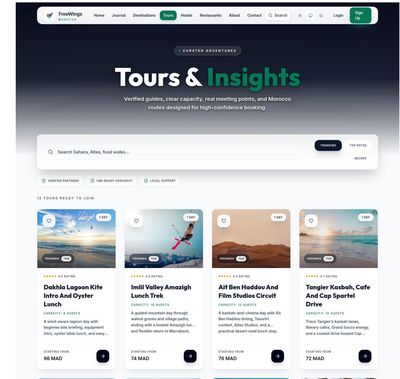
FreeWings demonstrates the harder thing: a coherent multi-entity marketplace experience, not a single CRUD module wearing a nice UI. The supplied 94-page report and interface captures show a complete discovery journey, detailed service pages, authentication, unified search, both payment-return states, and editorial content — the full shape of a real product, not a slice of one.
Verified evidence
- 94-page final-cycle report with architecture and UML
- Real UI captures for catalogues, detail pages, search and authentication
- Payment-return screens for pending and failed states
- Documented CMI signature, idempotency and reconciliation design
- Health, request telemetry and Web Vitals architecture
Current limitations
- Developed by two contributors and never presented as a solo build.
- CMI was implemented in certification/preproduction mode, not proven live commerce.
- Bearer-token storage in localStorage should be hardened because it increases XSS exposure.
- No independent production load test or security audit is claimed.
| STATUS | Two-person academic product · Functional demonstration |
|---|---|
| TEAM | Two-person project |
| DEMO | Functional demo deployment planned |
| SOURCE | Private project source |
POURQUOI CE PROJET COMPTE
One coherent product experience across discovery, reservation and payment states.
Cette étude de cas est conçue pour être vérifiable : les affirmations fortes sont étayées par des captures d'écran, des preuves sources ou des limites explicitement énoncées.